Feeding Basics6 min read
How Much Fresh Food Should Your Dog Eat a Day?
By The CBE Pet Kitchen team, Cooks at CBE Pet Kitchen, Coimbatore
Key takeaways
- Start from weight, then adjust for energy.
- Calm dogs about 10% less, very active dogs about 10% more.
- Check body shape every week or two and change the grams slowly, 50 g at a time.
- Treats and table food count. Keep them to about a tenth of the day's food.
The right amount of fresh food starts with your dog's weight. Find your dog on the table below, adjust for how active they are, and then watch their body shape for a couple of weeks. Every dog is a little different, so the table is a starting point, not a rule.
Most of us feed our dogs the way we were fed as children: a full bowl means love. Dogs don't need a full bowl to feel loved. They need the right amount, at the same times each day, and someone paying attention to how they look and move. This guide shows you how to find that amount and keep it right as your dog changes.
How many grams of fresh food a day by weight?
These are the starting amounts our kitchen uses for a moderately active adult dog. They are the same suggestions you see when you pick your dog's weight on Plans & Prices.
| Dog's weight | Fresh food a day |
|---|---|
| Up to 2 kg | 150 g |
| 2 to 3.5 kg | 200 g |
| 3.5 to 5 kg | 250 g |
| 5 to 6 kg | 300 g |
| 6 to 9 kg | 400 g |
| 9 to 12 kg | 500 g |
| 12 to 16 kg | 650 g |
| 16 to 21 kg | 800 g |
| 21 to 26 kg | 950 g |
| Over 26 kg | 1000 g, and message us |
If you don't know your dog's weight, start at 650 g a day and adjust from there.
How do I find my dog's weight?
Weigh yourself on a bathroom scale, then pick up your dog and weigh yourself again. The difference is your dog's weight. For dogs too big to lift, ask your vet to weigh them at the next visit; many clinics will do it in a minute. Write the number down with the date, so you can compare later.
How does energy change the amount?
A dog who sleeps most of the day needs less than one who runs every morning. As a simple rule:
- Calm or older dogs: about 10% less than the table.
- Moderately active dogs: the table as it is.
- Very active dogs: about 10% more than the table.
We round every portion to the nearest 50 g, so a calm 10 kg dog would start at 450 g instead of 500 g.
Be honest about energy. A dog in a flat who gets two 20-minute walks a day is moderately active at best, even if they bounce around when you come home. A dog who runs beside a cycle every morning, or works on a farm, is very active. Most city dogs sit in the middle or the calm row.
Do puppies, older dogs and nursing mothers need different amounts?
Yes, and the table above isn't meant for them.
- Puppies grow fast and need more food for their size, changing month by month. Ask your vet how much your puppy should eat and how often.
- Older dogs usually move less and may need less food, but some lose weight with age and need more. Watch their body shape closely.
- Pregnant or nursing mothers need much more food than usual. Follow your vet's advice.
- Dogs after neutering or spaying often need less food than before, because their energy needs can drop. Weigh them a month after surgery and adjust.
How do I know if the amount is right?
Look at and feel your dog's body every week or two:
- Run your hands along their sides. You should feel the ribs under a thin layer, without pressing hard.
- Look from above. There should be a gentle waist behind the ribs.
- Look from the side. The belly should tuck up a little behind the chest.
If your dog looks too round, go down 50 g. If you can see the ribs clearly or your dog seems hungry all the time, go up 50 g. If your dog's weight changes quickly without a reason you know of, talk to your vet.
A coat can hide a lot. On a fluffy dog, your hands tell you more than your eyes, so always feel as well as look.
Do treats and table food count?
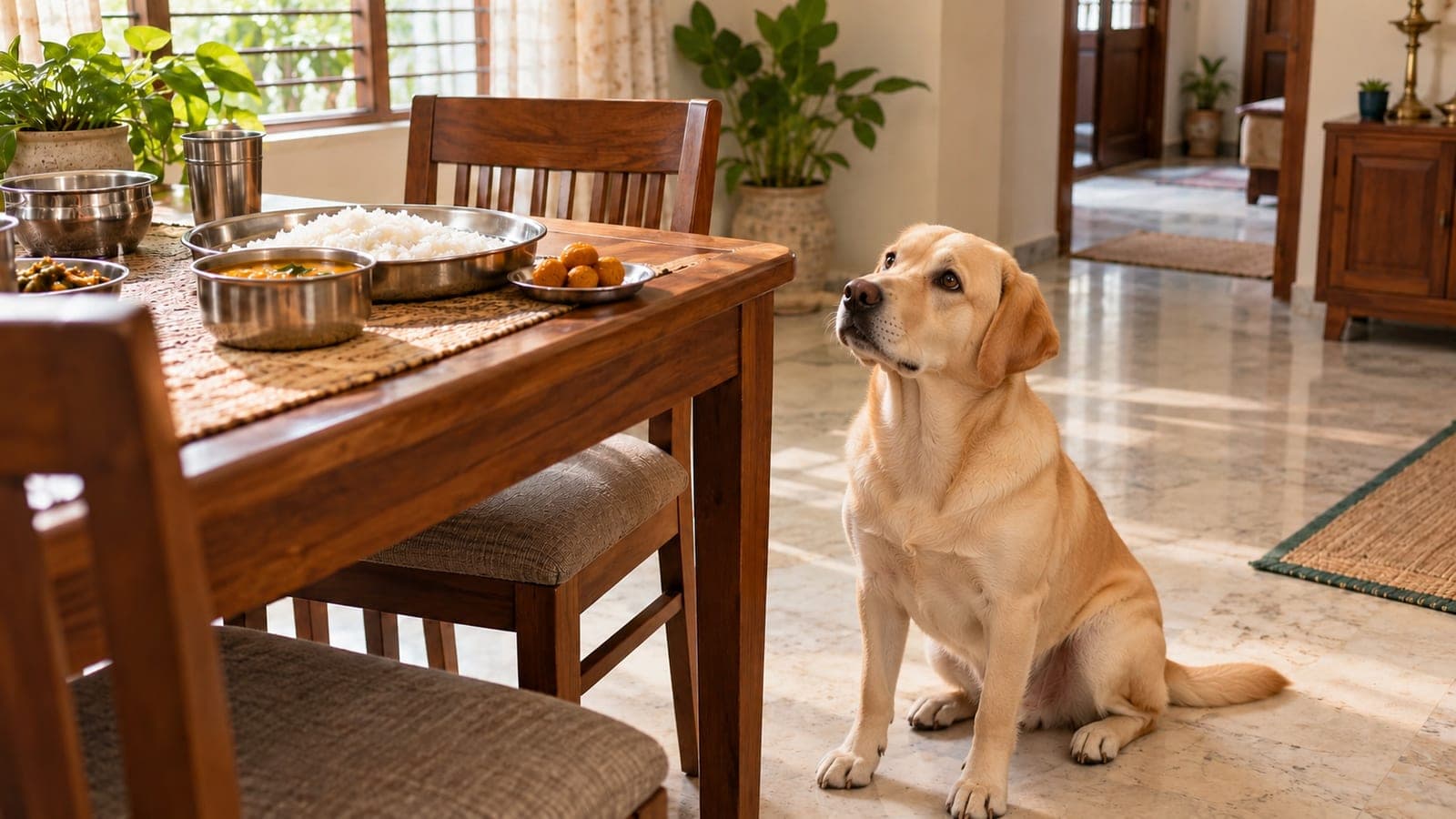
Yes. Everything your dog eats counts towards the day, and in many homes the extras add up to more than people think: a biscuit with morning tea, a piece of chapati at lunch, a bite of everyone's dinner. A common guideline is to keep treats and extras to about a tenth of the day's food.
If the whole family feeds your dog, agree on one person who gives treats, or put the day's treats in a small box each morning. When the box is empty, treats are done. And if your dog starts leaving food in the bowl, the extras are often the reason; our guide on why a dog won't finish their food goes through the others.
How should I split the day's food?
Most adult dogs do well on two meals a day, morning and evening, with the daily grams divided between them. Small dogs and some older dogs do better on three smaller meals. Feed at the same times every day; dogs settle into a routine quickly, and a routine makes it easier to notice when something is off.
Fresh food can come in one pack for the day or split into two packs, one per meal, which saves you measuring each time. Either way, keep the day's food in the fridge and use it within 24 hours.
What are the most common portion mistakes?
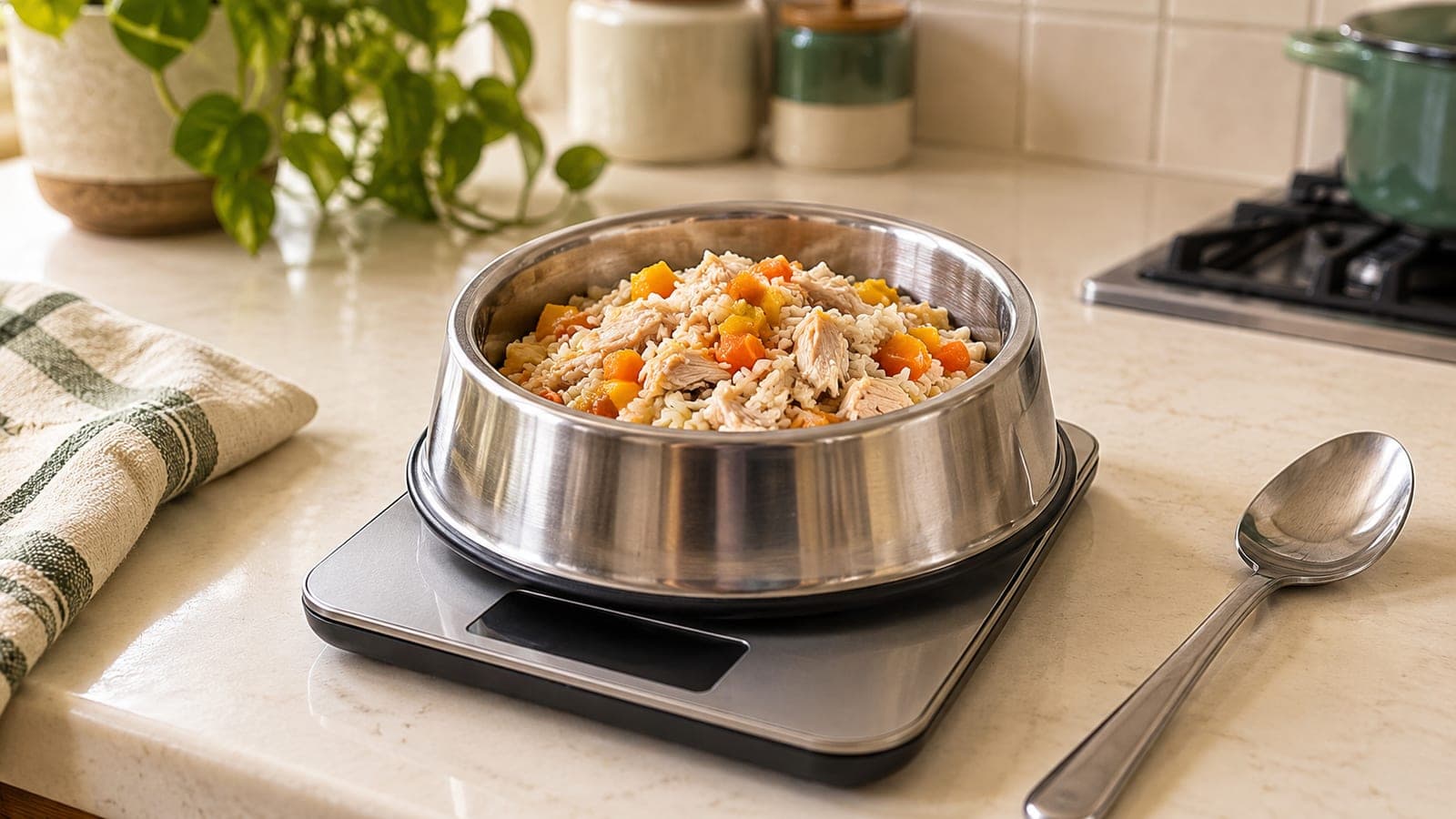
- Feeding by bowl size. A big bowl invites a big portion. Weigh the food, not the bowl.
- Feeding by cups or scoops. Fresh food and kibble weigh very differently for the same scoop.
- Guessing the dog's weight. A few kilos either way moves the portion by a whole row in the table.
- Feeding twice by accident. In busy homes, two people sometimes feed the same meal. A simple tick on the fridge door solves it.
- Changing too much at once. Big jumps in food make it hard to see what's working.
Does the right amount change through the year?
Yes, a little. The right amount follows your dog's life, so check it whenever their routine changes:
- Hot months. Many dogs move less and eat a little less in April and May. If they leave food, reduce by 50 g rather than letting food sit in the bowl.
- Cooler, active months. Longer walks and more play in the cooler months can mean a dog needs a little more.
- A change at home. A new walker, a move to a flat with less space, or a family member at home all day can change how much your dog moves.
- After illness or surgery. Follow your vet's advice on amounts while your dog recovers, then go back to body shape checks.
Does the recipe change how much to feed?
Our suggested daily grams are the same for every recipe on the menu, so you can switch recipes without changing the amount. You can see every recipe and what goes into it on Our Food. If you're moving your dog from kibble, follow our 7-day switch from kibble to fresh food and keep the total amount steady while the mix changes.
The short version
Find your dog's weight, read the starting grams from the table, adjust 10% for energy, and check their body shape every week or two. Change by 50 g at a time, count the treats, and ask your vet about puppies, older dogs and nursing mothers. Weigh, check, adjust, and repeat every couple of weeks.
Common questions
My dog's weight isn't on the table. What should I feed?
If you don't know your dog's weight, start at 650 g a day and adjust by body shape. If your dog is over 26 kg, message us on WhatsApp and we'll work out the right amount together.
Should puppies eat the same amount?
Puppies grow fast and their needs change month by month. The table is for adult dogs, so ask your vet for a puppy's daily amount.
How do I split the day's food?
Most adult dogs do well on two meals, morning and evening. Divide the daily grams between them.
How do I weigh my dog at home?
Weigh yourself, then weigh yourself holding your dog, and subtract. For big dogs, your vet's scale is easier and more accurate.
My dog always seems hungry. Should I feed more?
Not straight away. Many dogs act hungry whatever they've eaten. Go by body shape, not begging. If your dog is lean and still hungry, add 50 g a day for two weeks and check again.
Find your dog's daily price
See your dog's daily price for every plan.